Transformations of Exponentials
As with other functions, various transformations can be applied to exponential functions. This can be expressed algebraically as:
These transformations can alter their key characteristics such as domain, range and intercepts. They include:
- \(a\) represents vertical stretch/compression
- \(k\) represents horizontal stretch/compression
- \(d\) represents horizontal shift
- \(c\) represents vertical shift
First, we can rewrite the new function as \(f(x)=4.5^{-3(x-2)}\) since \(k\) needed to be factored out.
Here is an ordered list of what transformations must be done to convert the original function into the new function:
- Shift the function down \(1\) unit \(-> f(x)=2(4.5)^x\)
- Vertically compress the function by a factor of \(\cfrac{1}{2} -> f(x)=4.5^x\)
- Horizontally compress the function by a factor of \(3\) and reflect in the y-axis \(-> f(x)=4.5^{-3x}\)
- Shift the function to the right by \(2\) units \(-> f(x)=4.5^{-3(x-2)}\)
Example
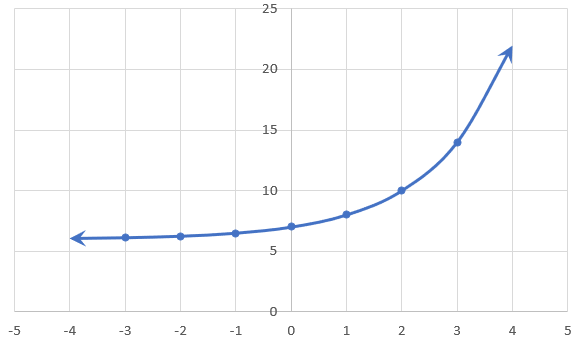
For the function \(f(x) = 0.5⁻ˣ+6\):
- Rewrite in simplified form and state the parent function
- State the transformations
- Sketch the transformed function
i. All we need to do to find the parent function is split the exponent (\(-x\)) into \(2\) parts and multiply the base by its coefficient:
\(f(x) = 0.5^{(-1)(x)}+6\)
\(f(x) = (0.5^{-1})^x+6\)
\(f(x) = \left(\cfrac{1}{0.5}\right)^x+6\)
\(f(x) = 2ˣ+6\)
Therefore, we can determine the parent function is \(\boldsymbol{f(x) = 2ˣ}\)
ii. We can identify the following transformations:
- \(\boldsymbol{a = 1}\): not really a transformation since its the default value
- \(\boldsymbol{c = 6}\): shifts function \(6\) units up
iii. We can first create a table of values to make it easier to draw the graph more accurately:
| x Values | -3 | -2 | -1 | 0 | 1 | 2 | 3 |
|---|---|---|---|---|---|---|---|
| y Values | 6.125 | 6.25 | 6.5 | 7 | 8 | 10 | 14 |
We can now draw our graph:
For the following exponential functions:
- Rewrite in simplified form and state the parent function
- State the transformations
- Sketch the transformed function
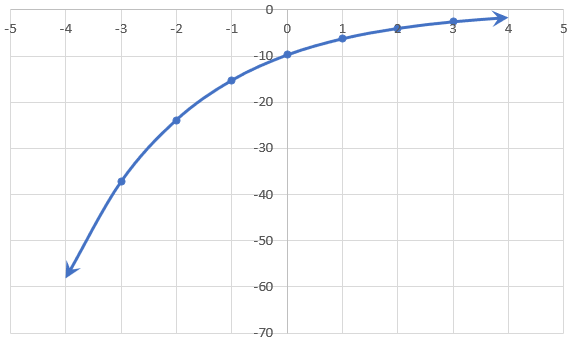
\(f(x)=-4(0.8)²ˣ⁻⁴\)
i. First, we can split the base into 2 separate parts, each with a different exponent:
After, we can factor the \(2\) out of \(2x\) and simplify the function by multipying each base by their respective exponent:
\(f(x)=-4(0.8)^{(2)(x)}(0.8)^{-4}\)
\(f(x)=-4(2.44140625)(0.8²)^x\)
\(f(x)=-9.77(0.64)^x\)
Therefore, we can determine that the parent function is \(f(x)=-9.77(0.64)^x\).
ii. We can identify the following transformations:
- \(\boldsymbol{a=-9.77}\): vertical stretch by a factor of \(9.77\) and Reflection in the \(x\)-axis
iii. We can first create a table of values to make it easier to draw the graph more accurately:
| x Values | -3 | -2 | -1 | 0 | 1 | 2 | 3 |
|---|---|---|---|---|---|---|---|
| y Values | -37.27 | -23.85 | -15.27 | -9.77 | -6.25 | -4 | -2.56 |
We can now draw our graph:
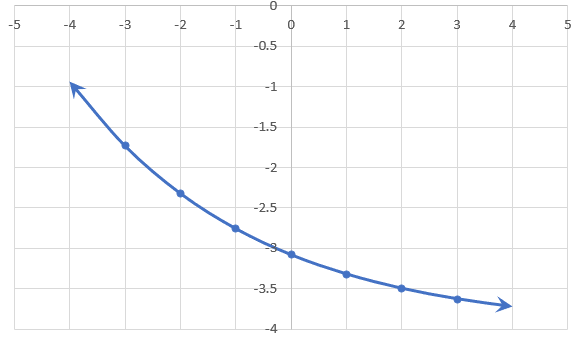
\(g(x)=0.5(2.5)^{\mathord{\frac{2-x}{3}}}-4\)
i. First, we can split the base into 2 separate parts, each with a different exponent:
After, we can factor the \(-1/3\) out of \(-x/3\) and simplify the function by multipying each base by their respective exponent:
\(g(x)=0.5(2.5)^{\frac{2}{3}}(2.5)^{\left(\frac{-1}{3}\right)(x)}-4\)
\(g(x)=0.5(2.5^{\mathord{\frac{2}{3}}})(2.5^{\frac{-1}{3}})^x-4\)
\(g(x)=0.5(1.842015749)(0.74)ˣ-4\)
\(g(x)=0.92(0.74)ˣ-4\)
Therefore, we can determine that the parent function is \(\boldsymbol{g(x)=0.92(0.74)ˣ-4}\).
ii. We can identify the following transformations:
- \(\boldsymbol{a=0.92}\): vertical compression by a factor of \(0.92\)
- \(\boldsymbol{c=-4}\): shifted down \(4\) units
iii. We can first create a table of values to make it easier to draw the graph more accurately:
| x Values | -3 | -2 | -1 | 0 | 1 | 2 | 3 |
|---|---|---|---|---|---|---|---|
| y Values | -1.73 | -2.32 | -2.76 | -3.08 | -3.32 | -3.50 | -3.63 |
We can now draw our graph:
Enter in the values for the exponential function or click on the button to generate random values. Entering these values will provide the characteristics for this particular function.