Exponential Growth and Decay
Exponential Growth and Decay occur when a physical quantity rapidly changes over a period of time.
Exponential Growth has several real-world applications such as bacterial growth, population increase and money growth schemes. Exponential Decay also has various real-world uses including food decay, half life, and radioactive decay.
Algebraically, exponential growth and decay are expressed as:
- \(f(x)\) represents the dependent variable
- \(a\) represents the intital value/\(y\)-intercept
- \(b\) represents the Growth/Decay Factor
- \(x\) represents the independent variable (usually time)
- \(c\) represents the period of growth/decay
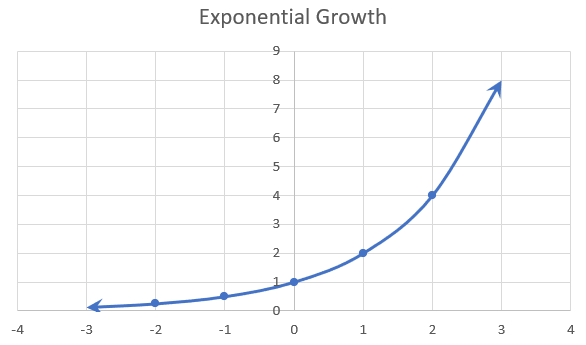
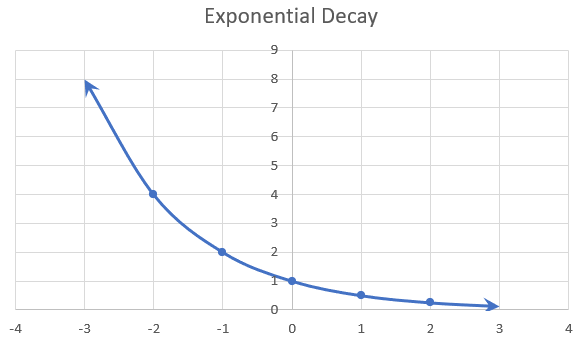
Note: Some exponential growth/decay scenarios that don't explicitly state their period of growth/decay have a default \(c\) value of \(1\).
Growth/Decay Factor
The Growth/Decay Factor \(b\) is used to determine whether the quantity rapidly increases or decreases. This can be found by identifying the Growth/Decay Rate, \(r\); this value gets added to or modifies \(b\).
These factor changes can be expressed as:- % Increase: \(b = 1 + r\)
- % Decrease: \(b = 1 - r\)
Regarding growth, if a quantity were to double in value each period, \(b = 2\). Likewise, if a quantity were to increase by 5% each period, \(b = 1.05\).
Conversely, regarding decay in relation to half-life, \(b = 0.5\). Similarly, if a quantity were to decrease by 8% each period, \(b = 0.92\).
Example
The value of the \($250\) thousand cottage increases by \(0.1\)% every month:
- Identify each variable and explain what they represent.
- Set up the formula
i. First, we can identify what each variable and value represents:
- \(V(m)\) represents the value of the cottage after each month
- \($250000\) represents the initial amount
- \(1.001\) represents the growth factor
- \(m\) represents the period of time in months where the value increases
ii. Next, using all the variables, we can set up our formula:
Therefore, we can represent this situation as \(\boldsymbol{V(m) = $250000(1.001)^m}\).
NOTE: It's very important to get the period of time correct. In this case, the cost inreases monthly, so the exponent needs to be in months. If the value was represented as a function of year \(V(y)\), the exponent would get changed to \(12y\) since there are 12 months in a year. The updated formula would be expressed as such:
The \(40\) grams of of radioactive matter within a mass decays at \(2\)% every minute.
First, we can identify what each variable and value represents:
- \(G(m)\) represents the amount of radioactive matter in grams remaining after each minute
- \(40\) represents the initial amount of radioacitve matter in grams
- \(0.02\) represents the percent the radioative matter decreases by every minute
- \(m\) represents the period of time in minutes where the radiactive matter decreases
Next, using all the variables, we can set up our formula:
\(G(m) = 40(1-0.02)^m\)
\(G(m) = 40(0.98)^m\)
Therefore, we can represent this situation as \(\boldsymbol{G(m) = 40(0.98)^m}\).
The \(200\) fruit fly population doubles every \(5\) days.
First, we can identify what each variable and value represents:
- \(F(d)\) represents the amount of fruit flies that exists after each day
- \(200\) represents the initial fruit fly population
- \(2\) represents the growth factor
- \(d\) represents the period in days where the fruit fly population increases
- \(5\) represents how often in days the fruit fly population doubles
Next, using all the variables, we can set up our formula:
Therefore, we can represent this situation as \(\boldsymbol{F(d) = 200(2)^{\frac{d}{5}}}\).
Solving Problems
Once we have all of our variables identified and our formulas set for each situation, we can use this information to identify how much of each respecitve quantity will grow or decay after a certain period of time.
Example
A drug's effectiveness decreases as time passes. Each hour the \(250\;[\text{mg}]\) drug loses \(5\)% of its effectiveness. How effective is the drug after \(150 \; [\text{minutes}]\)?
First, we can identify what each variable and value represents:
- \(E(h)\) represents the drug's affectiveness
- \(250\) represents the initial amount of the drug
- \(0.05\) represents the percentage of effectiveness the drug loses each hour
- \(h\) represents the amount of time in hours where the drug loses its effectiveness
- \(2.5\) represents the period of time in hours
Next, using all the variables, we can set up our formula:
\(E(h) = 250(1-0.05)^h\)
\(E(h) = 250(0.95)^h\)
Finally, using this formula, we are able to determine the drug's effetiveness after \(150\) minutes:
\(E(2.5) = 250(0.95)^{\mathord{2.5}}\)
\(E(2.5) = 250(0.879648189)\)
\(E(2.5) = 219.91 = 220\;[\text{mg}]\)
Therefore, we can determine that \(\boldsymbol{220\;[\textbf{mg}]}\) of the drug will remain after \(150 \; [\text{minutes}]\).