Linear Systems
A Linear System is a set of 2 or more Linear Equations that are analyzed at the same time. It is recommended you first view this lesson to better understand how linear equations work.
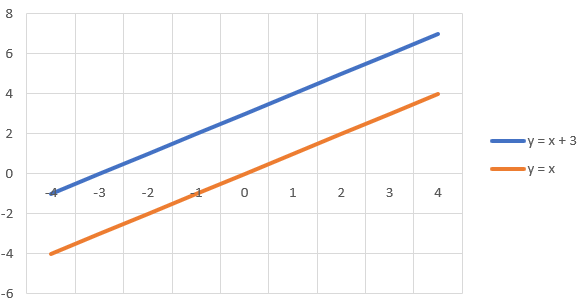
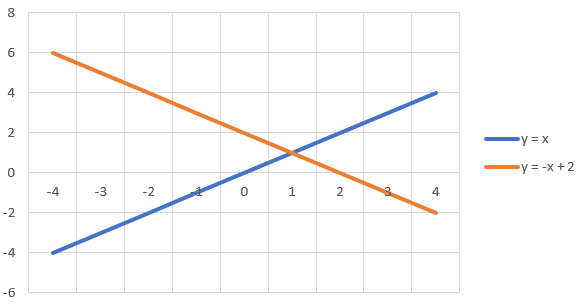
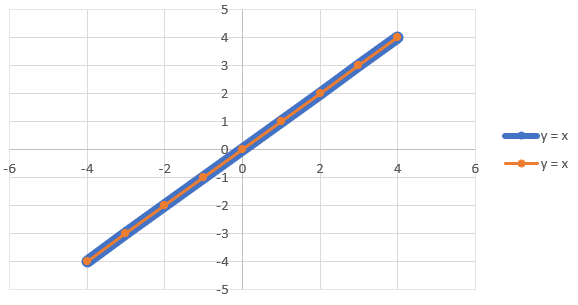
The point at which 2 lines cross is called the Point of Intersection. In a linear system, there are 3 unique cases for intersection:
- Lines don't intersect; this means that they are parallel to one another:
- Lines only intersect at one point; this is the most common form of linear system:
- Lines intersect infinetely at every point; this means that the lines/equations are the exact same:
Methods for Solving Linear Systems
There are \(3\) main methods for solving linear systems:
Graphing Method
- The simplest but least accurate way of portraying the relationships between the set of lines.
- All you need to do is graph the set of lines based on their resepctive equations to see if or where they intersect
- Before graphing the lines, we can create a table of values to identify where each point of the respective lines lie
We can sketch a graph of both lines to determine where they intersect:
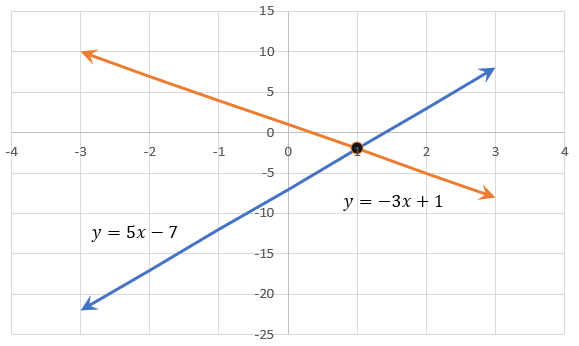
By graphing the 2 lines, we can identify the Point of Intersection as \((1,-2)\).
Additionally, we could make a table of values before graphing the equations to check if there is a Point of Intersection:
| x Values | -3 | -2 | -1 | 0 | 1 | 2 | 3 |
|---|---|---|---|---|---|---|---|
| y = 5x-7 | -22 | -17 | -12 | -7 | -2 | 3 | 8 |
| y = -3x+1 | 10 | 7 | 4 | 1 | -2 | -5 | -8 |
Substitution Method
ExampleUsing the substitution method, we can solve the linear system with linear equations \(8x - y = 10\) and \(3x - y = 9\)
First, we can solve one linear equation for \(x\) in terms of \(y\):
\(8x - y = 10\)
\(y = 8x - 10\)
Next, we can substitute that expression for \(y\) in the other linear equation:
\(3x - (8x - 10) = 9\)
\(3x - 8x + 10 = 9\)
Then, we can solve this system to determine the \(x\)-coordinate of the Point of Intersection:
\(3x - 8x = 9 - 10\)
\(-5x = -1\)
\(\cfrac{\cancel{-5}x}{\cancel{-5}} = \cfrac{-1}{-5}\)
\(x = 0.2\)
Finally, we can plug P\(x\), \(0.2\), into either equation to determine the corresponding \(y\)-coordinate and the Point of Intersection:
\(8(0.2) - y = 10\)
\(1.6 - y = 10\)
\(- y = 10 - 1.6\)
\(-y = 8.4\)
\(\cfrac{\cancel{-}y}{\cancel{-1}} = \cfrac{8.4}{-1}\)
\(y = -8.4\)
Therefore, we can determine that the Point of Intersection is \(\boldsymbol{(0.2, -8.4)}\).
NOTE: You can also start by solving for \(x\) in terms of \(y\) using the same steps outlined above.
Elimination Method
ExampleUsing the elimination method, we can solve the linear system with linear equations \(4 + y -3x = 0\) and \(x + y = 8\)
First, we can align all the terms in both equations so they share the same form (ie slope-intercept form):
\(y_1 = 3x - 4\)
\(y_2 = -x + 8\)
Next, we can add or subtract a multiple of one equation to (or from) the other equation so that the terms cancel each other out:
\(3(y = -x + 8)\)
\(3y = -3x + 24\)
\((3y + y) = (-3x + 3x) + (24 - 4)\)
\(4y = 20\)
\(\cfrac{\cancel{4}y}{\cancel{4}} = \cfrac{20}{4}\)
\(y = 5\)
Then, we can solve for \(x\) by substituting the \(y\)-value, \(5\), into one of the original equations:
\(4 + 5 -3x = 0\)
\(-3x = -9\)
\(\cfrac{\cancel{-3}x}{\cancel{-3}} = \cfrac{-9}{-3}\)
\(x = 3\)
Therefore, we can determine that the Point of Intersection is \(\boldsymbol{(3, 5)}\).
Substitution Method
Since \(y = 7x + 3\) is already expressed in terms of \(y\), we will substitute this expression for \(y\) in \(x - y = 3\):
\(x -(7x + 3) = 3\)
\(x -7x - 3 = 3\)
Next, we can solve this system to determine the \(x\)-coordinate for the Point of Intersection:
\(x - 7x = 3 + 3\)
\(-6x = 6\)
\(\cfrac{\cancel{-6}x}{\cancel{-6}} = \cfrac{6}{-6}\)
\(x = -1\)
Finally, we can plug the \(x\)-value (\(-1\)) into either equation to determine the corresponding \(y\)-coordinate and the Point of Intersection:
\(y = 7(-1) + 3\)
\(y = -7 + 3\)
\(y = -4\)
Thus, we can determine that the Point of Intersection is \(\boldsymbol{(-1, -4)}\).
Elimination Method
First, align all the terms in both equations so they share the same form (\(y = mx + b\)):
\(y_1 = 7x + 3\)
\(y_2 = x - 3\)
Add or subtract a multiple of one equation to (or from) the other equation so that the terms cancel each other out:
\(7(y = x - 3)\)
\(7y = 7x - 21)\)
\((y - 7y) = (7x - 7x) + (3 - (-21))\)
\(-6y = 24\)
\(\cfrac{\cancel{-6}y}{\cancel{-6}} = \cfrac{24}{-6}\)
\(y = -4\)
Next, solve for \(x\) by substituting the \(x\)-value into one of the original equations:
\(-4 = 7x + 3\)
\(7x = 3 + 4\)
\(7x = 7\)
\(\cfrac{\cancel{7}x}{\cancel{7}} = \cfrac{7}{7}\)
\(x = 1\)
Therefore, we can determine that the Point of Intersection is \(\boldsymbol{(1, -4)}\).