Fibonacci Sequence
The Fibonacci Sequence is a sequence in which the next term (or number) is found by adding together the 2 preceding terms. For example, \(2\) is found by adding together \(1\) and \(1\), \(3\) is found by adding together \(2\) and \(1\), etc. The Fibonacci Sequence can be expressed as:
- \(\textcolor{magenta}{n}\) represents the term number
- \(\textcolor{red}{x_n}\) represents the current term
- \(\textcolor{green}{x_{n-1}}\) represents the preceding term
- \(\textcolor{blue}{x_{n-2}}\) represents 2 terms preceding \(x_n\)
| Term Number (n) | 0 | 1 | 2 | 3 | 4 | 5 | 6 | 7 | 8 | 9 | 10 |
|---|---|---|---|---|---|---|---|---|---|---|---|
| Term Value (xₙ) | 0 | 1 | 1 | 2 | 3 | 5 | 8 | 13 | 21 | 34 | 55 |
The Fibonacci Sequence can be visually represented as such. Notice how the spiral evenly increases in size as it gradually moves outward:
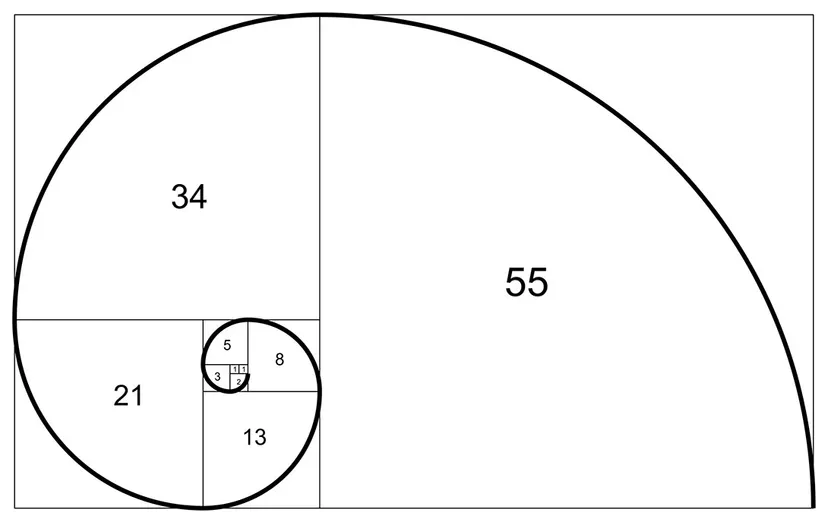
The terms in the Fibonacci Sequence are patterned even, odd, odd, even, odd, odd, even, etc. This is because adding together 2 odd numbers will always produce an even number but adding together an even and odd number will always produce an odd number.
Another interesting pattern in the Fibonacci sequence is how every nth term is a multiple of \(x_n\):
- \(x_3 = 2\); every third number is a multiple of 2 (\(2, 8, 34\))
- \(x_4 = 3\); every fourth number is a multiple of 3 (\(3, 21, 144\))
- \(x_5 = 5\); every fifth number is a multiple of 5 (\(5, 55, 610\))
Example
Determine the term value for \(x_8\).
Using the table above, we can identify the \(2\) previous values as \(13\) and \(8\). We can add them together to determine \(x_8\):
\(\textcolor{red}{x_8} = \textcolor{green}{x_7} + \textcolor{blue}{x_6}\)
\(\textcolor{red}{x_8} = \textcolor{green}{13} + \textcolor{blue}{8}\)
\(\textcolor{red}{x_8 = 21}\)
Therefore, we can determine that \(\boldsymbol{x_8 = 21}\).
First, we need to determine the value for \(x_9\). We can identify the previous 2 values as \(21\) and \(13\). We can add them together to determine \(x_9\).
\(\textcolor{red}{x_9} = \textcolor{green}{x_8} + \textcolor{blue}{x_7}\)
\(\textcolor{red}{x_9} = \textcolor{green}{21} + \textcolor{blue}{13}\)
\(\textcolor{red}{x_9 = 34}\)
We can now determine \(x_{10}\) by adding its 2 previous terms together (\(34\) and \(21\)).
\(\textcolor{red}{x_{10}} = \textcolor{green}{x_9} + \textcolor{blue}{x_8}\)
\(\textcolor{red}{x_{10}} = \textcolor{green}{34} + \textcolor{blue}{21}\)
\(\textcolor{red}{x_{10} = 55}\)
Therefore, we can determine that \(\boldsymbol{x_{10} = 55}\).
Golden Rule
The Golden Rule states that when we divide 2 successive Fibonacci terms, their ratio will approximate the Golden Ratio, \(1.618034\). The larger the pair of Fibonacci numbers, the closer the ratio will be to the approximate value. This can be expressed algebraically as:
- \(\textcolor{magenta}{n}\) represents the term number
- \(\textcolor{red}{x_n}\) represents the current term value
- \(\textcolor{olive}{\phi}\) represents the Golden Ratio (\(1.618034\))
Outlined below are a few examples to show how the larger values lead to a closer ratio value.
First, we can find the ratio of the second and first terms:
\(\textcolor{olive}{\phi} = \cfrac{x₂}{x₁}\)
\(\textcolor{olive}{\phi} = \cfrac{1}{1}\)
\(\textcolor{olive}{\phi} = 1\)
Next, we can find the ratio of the sixth and fifth terms:
\(\textcolor{olive}{\phi} = \cfrac{x₆}{x₅}\)
\(\textcolor{olive}{\phi} = \cfrac{8}{5}\)
\(\textcolor{olive}{\phi} = 1.6\)
Then, we can find the ratio of the tenth and ninth terms:
\(\textcolor{olive}{\phi} = \cfrac{x₁₀}{x₉}\)
\(\textcolor{olive}{\phi} = \cfrac{55}{34}\)
\(\textcolor{olive}{\phi} = 1.617647\)
We can also determine any Fibonacci number using the Golden Ratio formula:
Example
Determine the term value for \(x_6\) using the Golden Ratio formula.
All we need to do is substitute \(6\) for \(n\) to determine the term value:
\(\textcolor{red}{x_6}=\cfrac{(\textcolor{olive}{1.618034})^{\textcolor{magenta}{6}}-(1-\textcolor{olive}{1.618034})^{\textcolor{magenta}{6}}}{\sqrt{5}}\)
\(\textcolor{red}{x_6}=\cfrac{17.94427266-(0.618034)^{\textcolor{magenta}{6}}}{\sqrt{5}}\)
\(\textcolor{red}{x_6}=\cfrac{17.94427266-0.055728096}{\sqrt{5}}\)
\(\textcolor{red}{x_6}=\cfrac{17.88854456}{\sqrt{5}}\)
\(\textcolor{red}{x_6 \approx 8}\)
Therefore, we can determine that \(\boldsymbol{x_6 \approx 8}\). We can confirm that the calculations are accurate using the table near the top of this lesson.
We can determine the next term of the Fibonacci sequence by multiplying the previous term by the Golden Ratio:
Example
Determine the value of \(x_7\).
All we need to do to determine \(x_7\) is multiply \(x_6\) (\(8\)) by the Golden Ratio:
\(\textcolor{red}{x_7} = (\textcolor{green}{8})(\textcolor{olive}{1.618034})\)
\(\textcolor{red}{x_7 = 12.94 \approx 13}\)
Therefore, we can determine that \(\boldsymbol{x_7 \approx 13}\). We can confirm that the calculations are accurate using the table near the top of this lesson.
All we need to do is substitute \(24\) for \(n\) in the Golden Ratio formula to determine the term value:
\(\textcolor{red}{x_{10}}=\cfrac{(\textcolor{olive}{1.618034})^{\textcolor{magenta}{10}}-(1-\textcolor{olive}{1.618034})^{\textcolor{magenta}{10}}}{\sqrt{5}}\)
\(\textcolor{red}{x_{10}}=\cfrac{122.9918779-(0.618034)^{\textcolor{magenta}{10}}}{\sqrt{5}}\)
\(\textcolor{red}{x_{10}}=\cfrac{122.9918779-0.00813062}{\sqrt{5}}\)
\(\textcolor{red}{x_{10}}=\cfrac{122.9837473}{\sqrt{5}}\)
\(\textcolor{red}{x_{10} \approx 55}\)
Therefore, we can determine that \(\boldsymbol{x_{10} \approx 55}\). We can confirm that the calculations are accurate using the table near the top of this lesson.