Geometric Sequences
Geometric Sequences are ordered sets of of numbers where consecutive terms are separated by a constant ratio.
They can be expressed algebraically with the explicit formula:
- \(\textcolor{blue}{n}\) represents the sequence position
- \(\textcolor{olive}{t_n}\) represents the term value in position n
- \(\textcolor{red}{a}\) represents the first term in any sequence
- \(\textcolor{green}{r}\) represents the common ratio
Geometric Sequences are similar to exponential functions since they involve constant ratios. An arithmetic sequence can be expressed in function notation as:
When graphed, the points of an geometric sequence should be visualized discretely rather than continuouly like a regular linear graph. This is because the terms in a sequence are distinct and separate from one another:
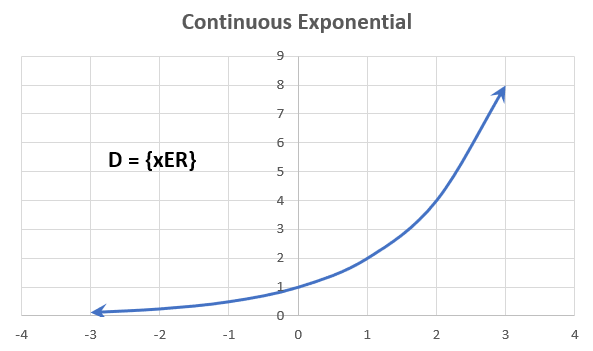
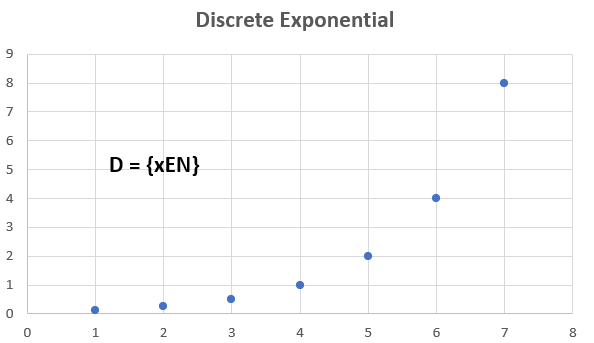
The continuous exponential graph has a domain of all real numbers, which consists of positive and negative values which can extend to both infinities. The discrete exponential graph conversely has a domain of all natural numbers, which only consists of detached positive integers starting from 1 which can extend to positive infinity depending on the sequence.
The formula for determining the recursive arthmetic function is:
The formula for determining the recursive arthmetic function is:
NOTE: The first term must be listed after the recursive formula since there is no previous term(s) it relies on to determine its value.
Example
For the sequence \(4, 12, 36, 108...,\) identify the following:
- The explicit formula
- The recursive formula
- The \(30\)th term
i. In order to determine the explicit formula, we must first identify the ratio:
We can first determine the ratio between the second and first terms:
\(\textcolor{green}{r_1} = \cfrac{\textcolor{olive}{12}}{4}\)
\(\textcolor{green}{r_1 = 3}\)
We can then determine the ratio between the third and second terms:
\(\textcolor{green}{r_2} = \cfrac{\textcolor{olive}{36}}{12}\)
\(\textcolor{green}{r_2 = 3}\)
We can then plug the ratio and the starting term into the geometric sequence formula to get the explicit formula:
\(\textcolor{olive}{t_n}=\textcolor{red}{a}(\textcolor{green}{r})^{\textcolor{blue}{n}-1}\)
\(\textcolor{olive}{t_n}=\textcolor{red}{4}(\textcolor{green}{3})^{\textcolor{blue}{n}-1}\)
ii. We can find the recursive formula using the equation shown at the start of the lesson, in addition to plugging in the initial value (\(4\)) and ratio (\(3\)).
\(\textcolor{olive}{t_n}=(t_{n-1})(\textcolor{green}{r}), t_1 =\textcolor{red}{a}\)
\(\textcolor{olive}{t_n}=(t_{n-1})(\textcolor{green}{3}), t_1 =\textcolor{red}{4}\)
iii. We can find the \(30\)th term by plugging the sequence number into the explicit formula, then solving for the rest:
\(\textcolor{olive}{t_n}=\textcolor{red}{4}(\textcolor{green}{3})^{\textcolor{blue}{30}-1}\)
\(\textcolor{olive}{t_n}=\textcolor{red}{4}(\textcolor{green}{3})^{29}\)
\(\textcolor{olive}{t_n \approx 2.7 \text{x} 10^{14}}\)
First, we can find the respective equations by plugging the values into the geometric sequence formula:
We can determine the first equation by plugging in the appropriate values and simplifying:
\(\text{E1}: \textcolor{olive}{t_5}=\textcolor{red}{a}(\textcolor{green}{r})^{\textcolor{blue}{5}-1}\)
\(\text{E1}: \textcolor{olive}{768}=\textcolor{red}{a}(\textcolor{green}{r})⁴\)
We can determine the second equation by plugging in the appropriate values and simplifying:
\(\text{E2}: \textcolor{olive}{t_9}=\textcolor{red}{a}(\textcolor{green}{r})^{\textcolor{blue}{9}-1}\)
\(\text{E2}: \textcolor{olive}{196608}=\textcolor{red}{a}(\textcolor{green}{r})⁸\)
We can then divide one equation from the other in order to determine the ratio. In this case, we will divide Equation 2 by Equation 1:
\(\cfrac{\textcolor{olive}{196608}}{\textcolor{olive}{768}} = \cfrac{\cancel{\textcolor{red}{a}}(\textcolor{green}{r})^8}{\cancel{\textcolor{red}{a}}(\textcolor{green}{r})^4}\)
\(256 = \textcolor{green}{r}^{8-4}\)
\((256)^{1/4} = (\textcolor{green}{r}^4)^{1/4}\)
\(\textcolor{green}{r = \pm \sqrt[4]{256}}\)
We can plug the ratio into one of the equations in order to get the initial value. In this case, we will use Equation 1:
\(\textcolor{olive}{768}=\textcolor{red}{a}(\textcolor{green}{4})^4\)
\(\cfrac{\textcolor{olive}{768}}{256} = \cfrac{\cancel{256}\textcolor{red}{a}}{\cancel{256}}\)
\(\textcolor{red}{a = 3}\)
We can now use all values to determine the general term (also known as the explicit formula):
\(\textcolor{olive}{t_n}=\textcolor{red}{a}(\textcolor{green}{r})^{\textcolor{blue}{n}-1}\)
\(\textcolor{olive}{t_n}=\textcolor{red}{3}(\textcolor{green}{4})^{\textcolor{blue}{n}-1}\) OR \(\textcolor{olive}{t_n}=\textcolor{red}{3}(\textcolor{green}{-4})^{\textcolor{blue}{n}-1}\)
Therefore, we can determine that the general term can be \(\boldsymbol{t_n = 3(4)^{n-1}}\) OR \(\boldsymbol{t_n = 3(-4)^{n-1}}\).
Example
Determine the # of terms in the sequence \(6, -12, 24, -48,...,-768\).
First, we can find the ratio in order to determine the explicit formula:
We can first determine the ratio between the second and first terms:
\(\textcolor{green}{r_1} = \cfrac{\textcolor{olive}{-12}}{6}\)
\(\textcolor{green}{r_1 = -2}\)
We can then determine the ratio between the third and second terms:
\(\textcolor{green}{r_2} = \cfrac{24}{-12}\)
\(\textcolor{green}{r_2 = -2}\)
We can plug all pertinent values into the explicit formula. We can then divide both sides by the same value:
\(\textcolor{olive}{t_n}=\textcolor{red}{a}(\textcolor{green}{r})^{\textcolor{blue}{n}-1}\)
\(\textcolor{olive}{-768}=\textcolor{red}{6}(\textcolor{green}{-2})^{\textcolor{blue}{n}-1}\)
\(\cfrac{\textcolor{olive}{-768}}{\textcolor{red}{6}} =\cfrac{\cancel{\textcolor{red}{6}}(\textcolor{green}{-2})^{\textcolor{blue}{n}-1}}{\cancel{\textcolor{red}{6}}}\)
\(-128 = (\textcolor{green}{-2})^{\textcolor{blue}{n}-1}\)
To determine the # of terms, rather than using trial and error, we can instead use logarithms. When using logarithms, the values MUST be positive!!
\(\cfrac{-128}{-1} = \cfrac{(\textcolor{green}{-2})^{\textcolor{blue}{n}-1}}{-1}\)
\(128 = (\textcolor{green}{2})^{\textcolor{blue}{n}-1}\)
\(\text{log}(128) = (\textcolor{blue}{n}-1)(\text{log}(2))\)
\(\textcolor{blue}{n}-1 = \cfrac{\text{log}(128)}{\text{log}(2)}\)
\(\textcolor{blue}{n}-1 = 7\)
\(\textcolor{blue}{n = 8}\)
Therefore, we can determine that this sequence has \(\boldsymbol{8}\) terms.
Marisa deposits \($12000\) in a savings account that pays compound annual interest at \(2\)%. She makes no other deposits. (Compound interest means that the interest grows by an increasing rate each year, because the interest is calculated on the amount deposited on the amount deposited as well as on the interest earned so far).
- Write the sequence of the year-end balances over \(4\) years
- Determine the general term formula in function notation
- At the end of some year, the balance in the account is \($13248.97\). For how long has the original deposit earned interest?
i. In order to determine the sequence, we must first identify how much the bank account increases year to year. We can do this by determining how much Marisa makes after a year. For additional reference, look at the Simple and Compound Interest lesson:
\(\text{A} = \textcolor{red}{P}\left(1 + \cfrac{\textcolor{green}{r}}{\textcolor{magenta}{c}}\right)^{\textcolor{magenta}{c}\textcolor{blue}{t}}\)
\(\text{A_1} = \textcolor{red}{12000}\left(1 + \cfrac{\textcolor{green}{0.02}}{\textcolor{magenta}{1}}\right)^{(\textcolor{magenta}{1})(\textcolor{blue}{1})}\)
\(\text{A_1} = \textcolor{red}{12000}(1 + 0.02)^1\)
\(\text{A_1} = \textcolor{red}{12000}(1.02)\)
\(\text{A_1} = 12240\)
We can now divide \(\text{A_1}\) by \(\text{A_0}\) to get the common ratio:
\(\textcolor{green}{r} = \cfrac{A_1}{A_0}\)
\(\textcolor{green}{r} = \cfrac{12240}{12000}\)
\(\textcolor{green}{r = 1.02}\)
Since Marisa makes an additional \(1.02 \%\) every year, we can exponentiate this amount by the # of years to determine our sequence:
We can first determine how much Marisa will have in total after \(2\) years:
\(\text{A_2} = \textcolor{red}{12000}(1.02)^{\textcolor{brown}{2}}\)
\(\text{A_2} = \textcolor{red}{12000}(1.0404)\)
\(\text{A_2} = 12484.80\)
We can next detemine how much Marisa will have in total after \(3\) years:
\(\text{A_3} = \textcolor{red}{12000}(\textcolor{green}{1.02})^{\textcolor{brown}{3}}\)
\(\text{A_#} = \textcolor{red}{12000}(1.061208)\)
\(\text{A_3} \approx 12734.50\)
We can next detemine how much Marisa will have in total after \(4\) years:
\(\text{A_4} = \textcolor{red}{12000}(\textcolor{green}{1.02})^{\textcolor{brown}{4}}\)
\(\text{A_4} = \textcolor{red}{12000}(1.08243216)\)
\(\text{A_4} \approx 12989.19\)
Therefore, we can determine our \(4\)-year sequence as \(\boldsymbol{12000, 12240, 12484.80, 12734.50, 12989.19}\).
ii. We can determine the function notation by plugging in the pertinent values. This should be simple as function notation for arithmetic functions is identical to the explicit function:
\(f(n)=\textcolor{red}{a}(\textcolor{green}{r})^{\textcolor{blue}{n}-1}\)
\(f(n) = \textcolor{red}{12000}(\textcolor{green}{1.02})^{\textcolor{blue}{n}-1}\)
Therefore, we can determine the function notation for this formula as \(\boldsymbol{f(n) = 12000(1.02)^{n-1}}\).
iii. We can identify the length of time the deposit has gained interest by plugging the balance into the function notation formula:
\(13248.97 = \textcolor{red}{12000}(\textcolor{green}{1.02})^{\textcolor{blue}{n}-1}\)
\(\cfrac{13248.97}{12000} = \cfrac{\cancel{\textcolor{red}{12000}}(\textcolor{green}{1.02})^{\textcolor{blue}{n}-1}}{\cancel{\textcolor{red}{12000}}}\)
\(1.104 = (\textcolor{green}{1.02})^{\textcolor{blue}{n}-1}\)
Instead of using trial and error to determine \(n\), we can instead use logarithms:
\(\text{log}(1.104) = \textcolor{blue}{n}-1\text{log}(\textcolor{green}{1.02})\)
\(\cfrac{\text{log}(1.104)}{\text{log}(1.02)} = \textcolor{blue}{n}-1\)
\(\textcolor{blue}{n} - 1 = 5\)
\(\textcolor{blue}{n = 6}\)
Therefore, we can determine that the deposit has been gaining interest for \(\boldsymbol{5 \; [\textbf{years}]}\). Since the first term represents the starting investment, the sixth term represents the end of the fifth year.