Properties of Parent Functions
Parent Functions are the most basic forms of a function. They can be transformed in several differnt ways in order to change characteristics such as domain, range, and intercepts.
- \(a\) represents the vertical stretch/compression factor
- \(k\) represents the horizontal stretch/compression factor
- \(d\) represents the horizontal shift
- \(c\) represents the vertical shift
Linear Functions
Linear Functions are represented graphically as straight lines that go through the origin. They contain slopes of \(1\) and are raised to a degree of \(1\).

The resepctive parent and general formulas for this function are:
The domain and range of the parent function are:
- Domain: \(\{x \in \mathbb{R}\}\)
- Range: \(y \in \mathbb{R}\)
| x Values | -3 | -2 | -1 | 0 | 1 | 2 | 3 |
|---|---|---|---|---|---|---|---|
| y Values | -3 | -2 | -1 | 0 | 1 | 2 | 3 |
Quadratic Functions
Quadratic Functions are represented graphically as U-shapes (also known as parabolas) with their vertexes at the origin. They are raised to a degree of \(2\).

The respective parent and general formulas for this function are:
The domain and range of the parent function are:
- Domain: \(\{x \in \mathbb{R}\}\)
- Range: \(\{y \in \mathbb{R} | y \ge 0\}\)
| x Values | -3 | -2 | -1 | 0 | 1 | 2 | 3 |
|---|---|---|---|---|---|---|---|
| y Values | 9 | 4 | 1 | 0 | 1 | 4 | 9 |
Constant Functions
Constant Functions are represented graphically as horizontal lines. They contain slopes of \(0\), and have the same output value for their respective input value, \(c\).
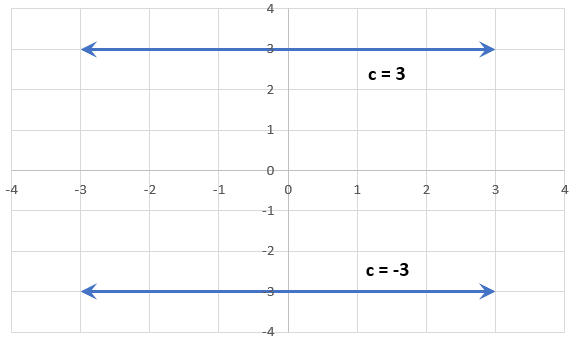
The parent formula is:
The domain and range of the parent function are:
- Domain: \(\{x \in \mathbb{R}\}\)
- Range: \(\{c\}\)
| x Values | -3 | -2 | -1 | 0 | 1 | 2 | 3 |
|---|---|---|---|---|---|---|---|
| y Values | 3 | 3 | 3 | 3 | 3 | 3 | 3 |
* In this instance, let's assume that \(\boldsymbol{c = 3}\).
Square Root Functions
Square Root Functions increase from left to right with its slope gradually decreasing. They begin at the origin and their final values are only defined for positive input values.
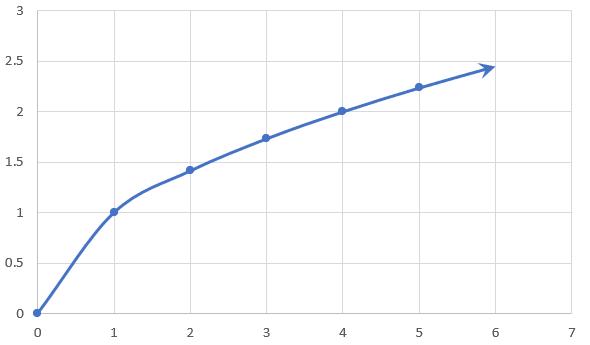
The respective parent and general formulas for this function are:
The domain and range of the parent function are:
- Domain: \(\{x \in \mathbb{R} | x \ge 0\}\)
- Range: \(\{y \in \mathbb{R} | y \ge 0\}\)
| x Values | 0 | 1 | 2 | 3 | 4 | 5 | 6 |
|---|---|---|---|---|---|---|---|
| y Values | 0 | 1 | 1.4 | 1.7 | 2 | 2.2 | 2.5 |
Reciprocol Functions
Reciprocol Functions have two main branches (or portions) in Quadrants \(1\) and \(3\). Their graphs approach \(x=0\) and \(y=0\), but never touches them since these areas are considered aymptotes, which are generally never touched or crossed.
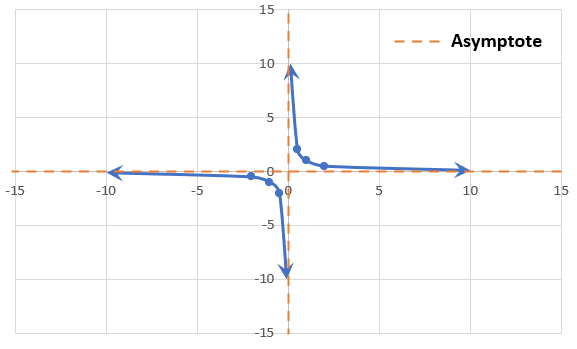
The respective parent and general formulas for this function are:
The domain and range of the parent function are:
- Domain: \(\{x \in \mathbb{R}| x \ne 0\}\)
- Range: \(\{y \in \mathbb{R} | y \ne 0\}\)
| x Values | -10 | -2 | -1 | -0.5 | -0.1 | 0 | 0.1 | 0.5 | 1 | 2 | 10 |
|---|---|---|---|---|---|---|---|---|---|---|---|
| y Values | -0.1 | -0.5 | -1 | -2 | -10 | U/D | 10 | 2 | 1 | 0.5 | 0.1 |
Cubic Functions
Cubic Functions are represented graphically as two halves of a parabola going in opposite directions. They are raised to a degree of \(3\) and have their vertexes at the origin.
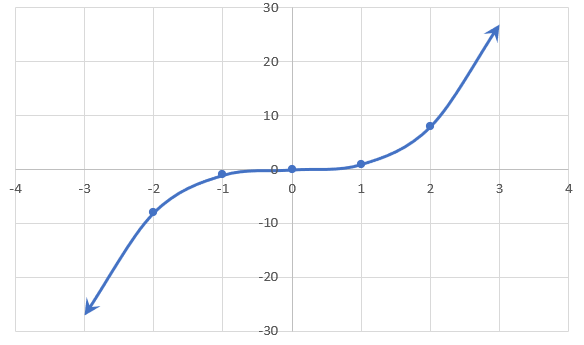
The respective parent and general formulas for this function are:
The domain and range of the parent function are:
- Domain: \(\{x \in \mathbb{R}\}\)
- Range: \(\{y \in \mathbb{R}\}\)
| x Values | -3 | -2 | -1 | 0 | 1 | 2 | 3 |
|---|---|---|---|---|---|---|---|
| y Values | -27 | -8 | -1 | 0 | 1 | 8 | 27 |
Cubic Root Functions
Cubic Root Functions are very similar to square root functions and act as inverses of cubic functions. The main difference is that their output values are defined for both positive and negative input values.
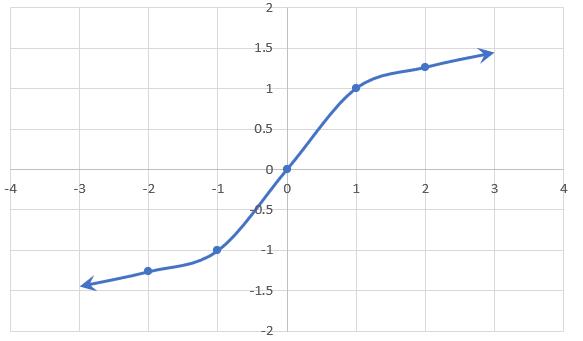
The respective parent and general formulas for this function are:
The domain and range of the parent function are:
- Domain: \(\{x \in \mathbb{R}\}\)
- Range: \(\{y \in \mathbb{R}\}\)
| x Values | -3 | -2 | -1 | 0 | 1 | 2 | 3 |
|---|---|---|---|---|---|---|---|
| y Values | 1.44 | -1.26 | -1 | 0 | 1 | 1.26 | 1.44 |
Absolute Value Functions
Absoulte Value Functions always have positive output values regardless of the input value. They are graphically represented as V-shapes with a cusp (or vertex) at the origin.
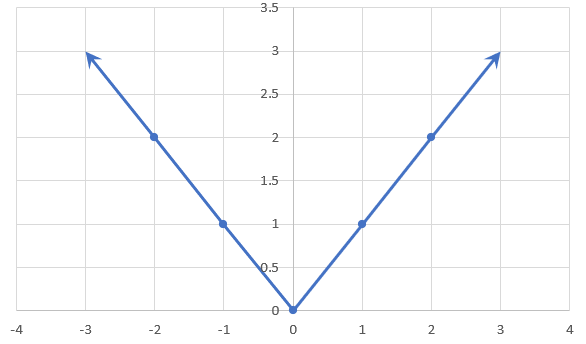
The respective parent and general formulas for this function are:
The domain and range of the parent function are:
- Domain: \(\{x \in \mathbb{R}\}\)
- Range: \(\{y \in \mathbb{R}| y \ge 0\}\)
| x Values | -3 | -2 | -1 | 0 | 1 | 2 | 3 |
|---|---|---|---|---|---|---|---|
| y Values | 3 | 2 | 1 | 0 | 1 | 2 | 3 |
Exponential Functions
Exponential Functions are represented as curves that either rapdily increase or decrease. Whereas Linear Functions change at a constant rate, Exponential Functions change by a common ratio.
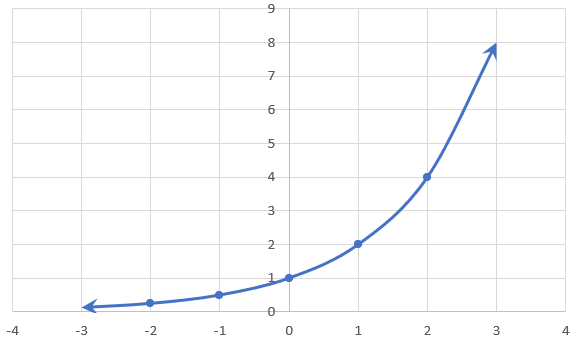
The respective parent and general formulas for this functions are:
The domain and range of the parent function are:
- Domain: \(\{x \in \mathbb{R}\}\)
- Range: \(\{y \in \mathbb{R} | y \gt 0\}\)
| x Values | -3 | -2 | -1 | 0 | 1 | 2 | 3 |
|---|---|---|---|---|---|---|---|
| y Values | 0.125 | 0.25 | 0.5 | 1 | 2 | 4 | 8 |
Sinusoidal Functions
Sinusoidal Functions are represented as waves that continously oscillate between peaks and valleys.
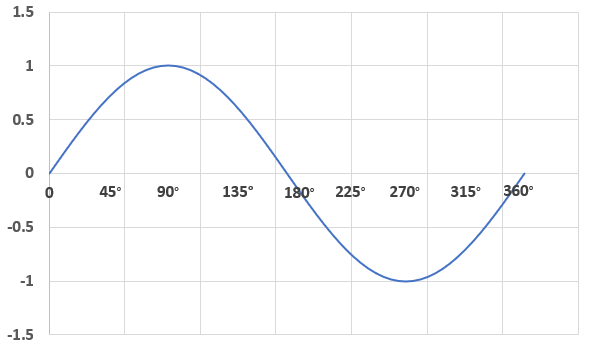
The respective parent and general formulas for this function are:
The domain and range of the parent function are:
- Domain: \(\{x \in \mathbb{R}\}\)
- Range: \(\{y \in \mathbb{R}|-1 \le y \le 1\}\)
| x Values | 0° | 30° | 45° | 60° | 90° | 180° | 210° | 225° | 240° | 270° | 360° |
|---|---|---|---|---|---|---|---|---|---|---|---|
| y Values | 0 | 0.5 | 0.71 | 0.87 | 1 | 0 | -0.5 | -0.71 | -0.87 | -1 | 0 |
Has a general function of \(f(x) = a(k(x-d)) + c\).
These are Linear Functions, \(\boldsymbol{f(x) = x}\).
Their domain and range are {\(x\in\mathbb{R} | x\ge0\)} and {\(y\in\mathbb{R} | y\ge0\)} respectively.
These are Square Root Functions, \(\boldsymbol{f(x) = \sqrt{x}}\).
They have slopes of \(0\).
These are Constant Functions, \(\boldsymbol{f(x) = c}\).
Has a transformed function of \(2(x-5)^2+10\)
These are Quadratic Functions, \(\boldsymbol{f(x) = x^2}\).