Intro to Functions
A Function is a mathematical expression usually written in the form \(f(x)\). It is used to represent the relation between the dependent variable, \(x\) and the independent variable, \(y\). The dependent and independent variables are also referred to as the input and output respectively.
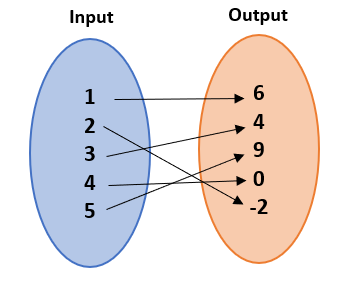
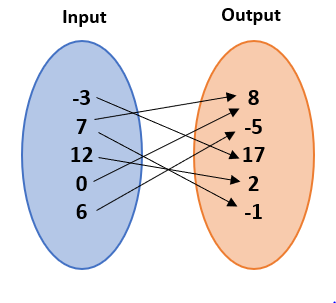
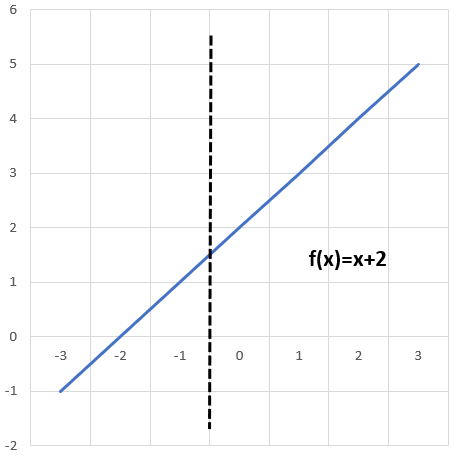
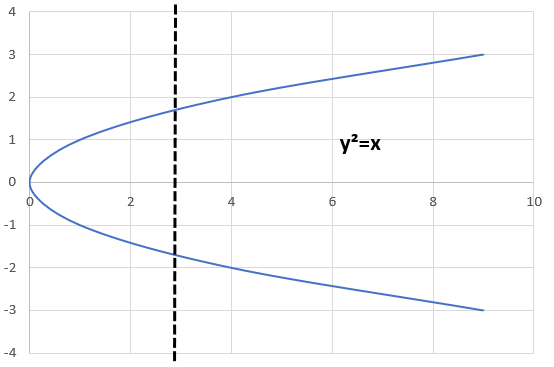
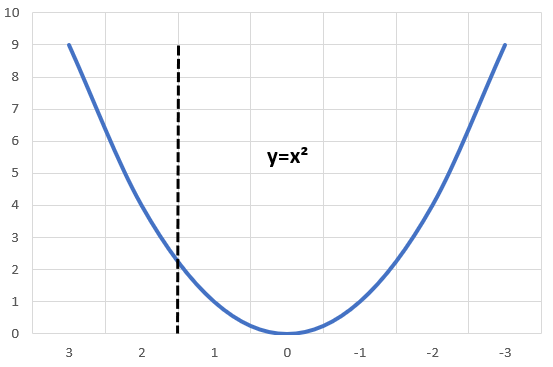
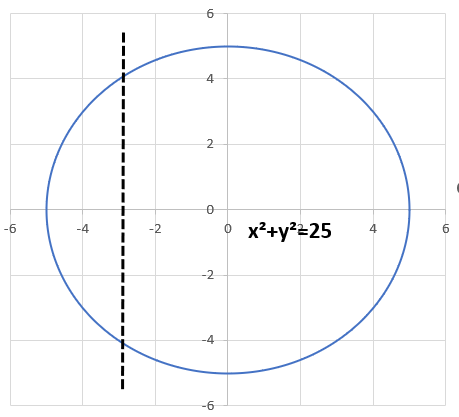
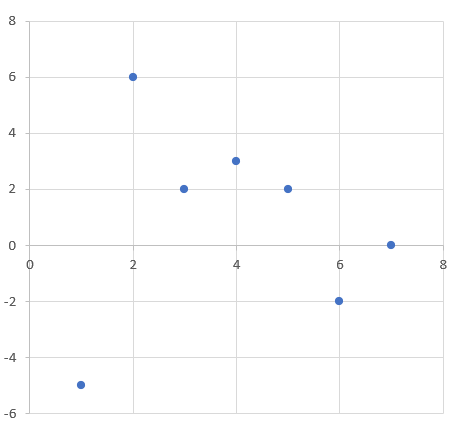
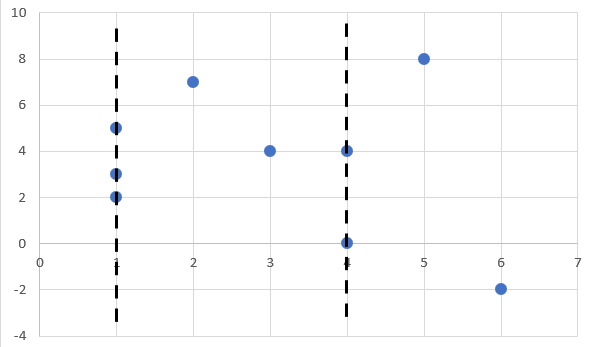
A function can only be referred to as such if the input produces only one output. This can be referred to as a one-to-one relation whereas an input with more than one output can be referred to as a one-to-many relation. A function can be identified graphically by using the vertical-line test. If the graph touches the line at \(2\) or more points, then it fails the test and is not considered a function.
A function also cannot have its output raised by a power (ie \(y^2\), \(y^4\), etc).
What are Functions?
| Functions | NOT Functions |
|---|---|
| \((1,2), (3,4), (5,6)\) | \((4,7), (8,2), (4,9)\) |
 |
 |
 |
 |
 |
 |
 |
 |
\((1,2),(3,7),(5,2),(6,9)\)
This is a function since each input only has \(1\) respective output.
\((7,4),(0,-5),(7,12),(-8,-2)\)
This is NOT a function since the input, \(7\), contains \(2\) corresponding outputs.
\(f(x)=-5x+9\)
This is a function since the equation is linear and will produce only interdependent outputs.
\(x^2+y^3=4\)
This is NOT a function since \(y\) is raised by a power (\(3\) in this case).
A vending machine produces pop, gum, chocolate bars, etc. depending on the button pressed
This is a function since each item has a specific button that needs to be pressed for it to get produced.
The input is the postal code and the output is the street address.
This is NOT a function since each postal code would have several corresponding street addresses.