Special Angles
Special Angles are angles that act as integer multiples of \(\cfrac{\pi}{6}\) radians (\(30°\)) and \(\cfrac{\pi}{4}\) radians (\(45°\)). They're classified as "special" since they're simple to work with without use of a calculator and provide precise answers.

Trigonometric Ratios of Special Angles
Using Right Triangles, we can easily identify how to identify the trigonometric ratios of \(30°\), \(45°\), and \(60°\).
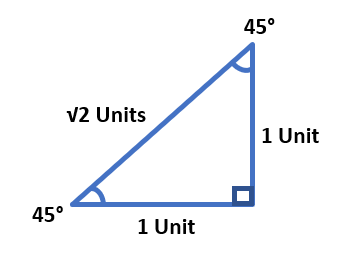
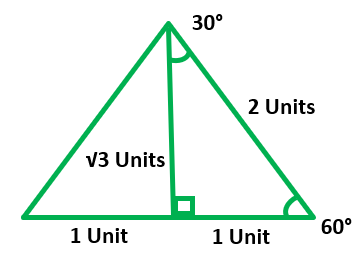
The information displayed by these triangles can be summarized by the table below:
| sin | cos | tan | |
| 30° | \(\cfrac{1}{2}\) | \(\cfrac{\sqrt{3}}{2}\) | \(\cfrac{1}{\sqrt{3}}\) |
| 45° | \(\cfrac{1}{\sqrt{2}}\) | \(\cfrac{1}{\sqrt{2}}\) | \(1\) |
| 60° | \(\cfrac{\sqrt{3}}{2}\) | \(\cfrac{1}{2}\) | \(\sqrt{3}\) |
It doesn't matter what the dimensions of the triangle are when measuring the angles since the ratios will always be the exact same. When evaluting a trigonometric value (ie \(\cos(30°)\)), make sure to display it as a trig ratio (ie \(\cfrac{\sqrt{3}}{2}\)) rather than the exact amount to prevent rounding errors.
Example
Find the exact value of \(\csc(330°)\) without using a calculator.
First, we can find the value by sketching a diagram of where the point lies on the terminal arm. This will give us an indication of what the right triangle will look like. Since \(\theta = 330°\), we can determine that it will lie in the 4th Quadrant and make a \(30°\) with the \(x\)-axis:

Since \(\csc\) is the reciprocol function of \(\sin\), it uses the ratio of \(\cfrac{\textcolor{blue}{r}}{\textcolor{green}{y}}\). Using the special triangle seen on the graph (\(30°\), \(60°\), \(90°\)), we can identify \(\textcolor{blue}{r} = \textcolor{blue}{2}\) and \(\textcolor{green}{y} = \textcolor{green}{-1}\).
Next, we can plug these values into the equation to get our final result:
\(\csc(330°) = \cfrac{\textcolor{blue}{r}}{\textcolor{green}{y}} = \cfrac{\textcolor{blue}{-2}}{\textcolor{green}{1}} = -2\)
Therefore, we can determine that \(\boldsymbol{\csc(330°) = -2}\).
First, we can find the value by sketching a diagram of where the point lies on the terminal arm. This will give us an indication of what the right triangle will look like:

Since \(\sec\) is the reciprocol function of \(\cos\), it uses the ratio of \(\cfrac{\textcolor{blue}{r}}{\textcolor{red}{x}}\). From the graph, we can identify \(\textcolor{blue}{r} = \(\textcolor{blue}{\sqrt{2}}\) and \(\textcolor{red}{x} = \textcolor{red}{-1}\).
Next, we can plug these values into the equation to get our final result:
\(\sec(225°) = \cfrac{\textcolor{blue}{r}}{\textcolor{red}{x}} = \cfrac{\textcolor{blue}{\sqrt{2}}}{\textcolor{red}{-1}} = -\sqrt{2}\)
Therefore, we can determine that \(\boldsymbol{\sec(225°) = -\sqrt{2}}\).
Example
For the point \(\text{P}(-2,-8)\), find the exact values of the \(3\) primary trigonometric ratios for the principal angle that is made with the terminal arm with point \(\text{P}\) on it.
In order to identify these ratios, we first need to determine what the radius is. To do so, we can use the Pythagorean Theorem:
\(\textcolor{red}{x}^2 + \textcolor{green}{y}^2 = \textcolor{blue}{r}^2\)
\((\textcolor{red}{-2})^2 + (\textcolor{green}{-8})^2 = \textcolor{blue}{r}^2\)
\(4 + 64 = \textcolor{blue}{r}^2\)
\(\sqrt{68} = \sqrt{r^2}\)
\(\textcolor{blue}{r} = \sqrt{4} . \sqrt{17}\)
\(\textcolor{blue}{r} = \textcolor{blue}{2\sqrt{17}}\)
We can now use the radius, \(2\sqrt{17}\), to determine the trigonometric ratios:
\(\cos\theta = \cfrac{\textcolor{red}{x}}{\textcolor{blue}{r}} = \cfrac{\textcolor{red}{-2}}{\textcolor{blue}{2\sqrt{17}}}\)
\(\sin\theta = \cfrac{\textcolor{green}{y}}{\textcolor{blue}{r}} = \cfrac{\textcolor{green}{-8}}{\textcolor{blue}{2\sqrt{17}}}\)
\(\tan\theta = \cfrac{\textcolor{green}{y}}{\textcolor{red}{x}} = \cfrac{\textcolor{green}{-8}}{\textcolor{red}{-2}} = 4\)
Therefore, we can determine that the respective trigonometric ratios for \(\cos\), \(\sin\), and \(\tan\) are \(\boldsymbol{\cfrac{\textcolor{red}{ -2}}{\textcolor{blue}{2\sqrt{17}}}}\), \(\boldsymbol{\cfrac{\textcolor{green}{ -8}}{\textcolor{blue}{2\sqrt{17}}}}\), and \(\boldsymbol{4}\).
First, we can find the angle by using the inverse trigonometric function:
\(\theta = \sin^{-1} \left(-\cfrac{\sqrt{3}}{2}\right)\)
\(\theta = -60°\)
We can't use \(-60°\) since that is equivalent to \(300°\), which is located in Quadrant \(4\). As a result, we can add it to \(180°\) to get its position in Quadrant \(3\):
\(\theta = 180° + 60°\)
\(\theta = 240°\)
Next, to determine the first set of coordinates, we can find the \(\cos\) and \(\sin\) of the \(x\) and \(y\)-coordinates respectively:
\(P_1 = (\cos240°, \sin240°)\)
\(P_1 = \left(-\cfrac{1}{2}, \cfrac{\sqrt{3}}{2}\right)\)
Then, to determine the second set of coordinates, we can multiply them by the same factor since the point is only located in Quadrant \(3\). In this instance, we will multiply the coordinates by a factor of \(5\):
\(P_2 = (5)\left(-\cfrac{1}{2}, \cfrac{\sqrt{3}}{2}\right)\)
\(P_2 = \left(-\cfrac{5}{2}, \cfrac{5\sqrt{3}}{2}\right)\)
Therefore, we can determine that \(\theta\) is \(\boldsymbol{240°}\) and \(2\) potential coordinates are \(\boldsymbol{\left(-\cfrac{1}{2}, \cfrac{\sqrt{3}}{2}\right)}\) and \(\boldsymbol{\left(-\cfrac{5}{2}, \cfrac{5\sqrt{3}}{2}\right)}\).
First, we can determine the respective values of each function by sketching graphs:


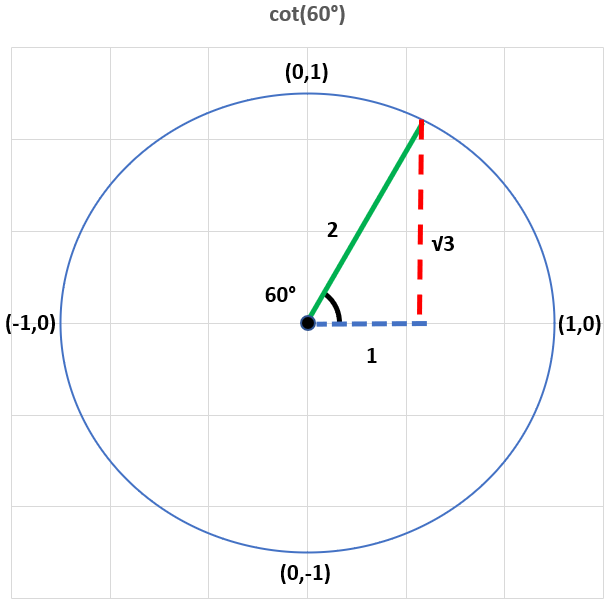

Next, we can plug these values into their respective trigonometric ratios to solve for the exact value:
\(= \sin(270°)\cos(45°)-\cot(60°)\sec(150°)\)
\(= \left(\cfrac{y}{r}\right)\left(\cfrac{x}{r}\right) - \left[\left(\cfrac{x}{y}\right)\left(\cfrac{r}{x}\right)\right]\)
\(= \left(\cfrac{-1}{1}\right) \left(\cfrac{1}{\sqrt{2}}\right) - \left[\left(\cfrac{1}{\sqrt{3}}\right)\left(\cfrac{2}{-\sqrt{3}}\right)\right]\)
\(= -\cfrac{1}{\sqrt{2}} - \left(-\cfrac{2}{3}\right)\)
\(= -\cfrac{1}{\sqrt{2}} + \cfrac{2}{3}\)
Then, we can multiply the first expression by \(\sqrt{2}\) in order to make its denominator a whole number:
\(= \left(\cfrac{\sqrt{2}}{\sqrt{2}}\right)\left(-\cfrac{1}{\sqrt{2}}\right) + \cfrac{2}{3}\)
\(= -\cfrac{\sqrt{2}}{2} + \cfrac{2}{3}\)
Finally, we can multiply each expression by the denominator of the other in order to create a common denominator (\(6\)):
\(= \left(\cfrac{3}{3}\right)\left(-\cfrac{\sqrt{2}}{2}\right) + \left(\cfrac{2}{2}\right)\left(\cfrac{2}{3}\right)\)
\(= -\cfrac{3\sqrt{2}}{6} + \cfrac{4}{6}\)
\(= \cfrac{-3\sqrt{2} + 4}{6}\)
Therefore, we can determine that the exact value of the expression is \(\boldsymbol{\cfrac{-3\sqrt{2} + 4}{6}}\).
Special Angle Calculator
Select a value for the Principal Angle. This function will then calculate the respective values for the Related Acute Angle as well as \(x\), \(y\), and \(r\).