Inverse Trigonometric Functions
Regular Trigonometric Functions are used to find the missing side length using a known side length and angle. Conversely, Inverse Trigonometric Functions are used to find a missing angle using \(2\) known side lengths.
The inverse of sine, for example, is represented as \(\sin^{-1}\).
The \(3\) Inverse Trigonometric Ratios can be represented as such:
- \(\theta = \sin^{-1}\left(\cfrac{\textcolor{red}{\text{opposite}}}{\textcolor{blue}{\text{hypoteneuse}}}\right) \)
- \(\theta = \cos^{-1}\left(\cfrac{\textcolor{green}{\text{adjacent}}}{\textcolor{blue}{\text{hypoteneuse}}}\right) \)
- \(\theta = \tan^{-1}\left(\cfrac{\textcolor{red}{\text{opposite}}}{\textcolor{green}{\text{adjacent}}}\right)\)
Example
Solve for \(\angle \text{P}\) if \(\sin\angle \text{P} = 0.5\)
To solve for \(\angle \text{P}\), we would use the inverse sin (\(\sin^{-1})\) to find the angle:
\(\angle \text{P} = \sin^{-1}(0.5)\)
\(\angle \text{P} = 30°\)
Therefore, we can determine that \(\boldsymbol{\angle \textbf{P} = 30°}\).
Example
Solve for \(\angle X\) for the following triangle.
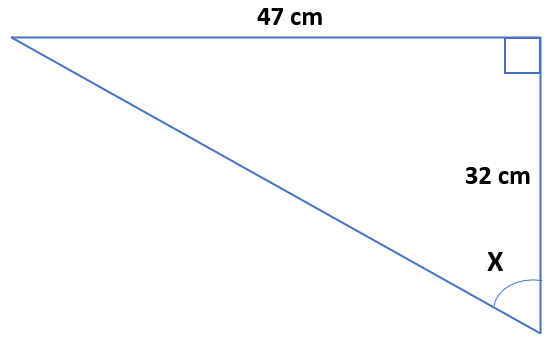
First, we can determine that \(\text{opposite} = 47\;[\text{cm}]\) and \(\text{adjacent} = 32\;[\text{cm}]\). Therefore, we can use the tan trig ratio in order to solve for \(\angle \text{X}\):
\(\text{tan}(\angle\text{X}) = \cfrac{\textcolor{red}{\text{opposite}}}{\textcolor{green}{\text{adjacent}}}\)
\(\text{tan}(\angle\text{X}) = \cfrac{\textcolor{red}{47}}{\textcolor{green}{32}}\)
\(\angle\text{X} = \text{tan}^{-1}\left(\cfrac{\textcolor{red}{47}}{\textcolor{green}{32}}\right)\)
\(\angle \text{X} = 55.75°\)
Therefore, we can determine that \(\boldsymbol{\angle \textbf{X} = 55.75°}\).
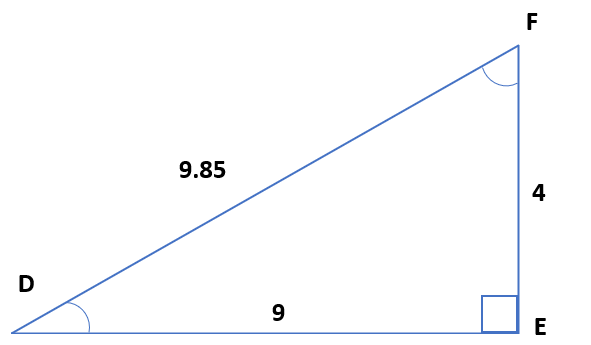
We can use the sine trigonometric function to determine the missing angle for \(\angle \text{D}\). To do, we can use \(\text{opposite} = 9\) and \(\text{hypoteneuse} = 9.85\):
\(\text{sin}(\angle \text{D}) = \cfrac{\textcolor{red}{\text{opposite}}}{\textcolor{blue}{\text{hypoteneuse}}}\)
\(\text{sin}(\angle \text{D}) = \cfrac{\textcolor{red}{4}}{\textcolor{blue}{9.85}}\)
\(\angle \text{D} = \text{sin}^{-1}\left(\cfrac{\textcolor{red}{4}}{\textcolor{blue}{9.85}}\right)\)
\(\angle \text{D} = 24°\)
We can subtract the sum of \(\angle \text{D}\) and \(\angle \text{E}\) by \(180^{\circ}\) in order to get the missing angle for \(\angle \text{F}\):
\(\angle \text{F} = 180° - (\angle \text{D} + \angle \text{E})\)
\(\angle \text{F} = 180° - (24° + 90°)\)
\(\angle \text{F} = 180° - 114°\)
\(\angle \text{F} = 66°\)
Therefore, we can determine that the missing angles are \(\boldsymbol{\angle \textbf{D} = 24°}\) and \(\boldsymbol{\angle \textbf{F} = 66°}\) respectively.
CAST
CAST is acronym used to memorize which quadrant each trigonometric ratios yield positive results:
- C: Quadrant \(4\), will yield positive results for \(\cos\) and negative results for \(\sin\) and \(\tan\)
- A: Quadrant \(1\), will yield positive results for all trigonometric functions
- S: Quadrant \(2\), will yield positive results for \(\sin\) and negative results for \(\cos\) and \(\tan\)
- T: Quadrant \(3\), will yield positive results for \(\tan\) and negative results for \(\cos\) and \(\sin\)
The relationship between between Quadrant and the Trigonometric Ratio sign can be summarized in the following table:
| sin | cos | tan | |
| Quadrant 1 | \(+\) | \(+\) | \(+\) |
|---|---|---|---|
| Quadrant 2 | \(+\) | \(-\) | \(-\) |
| Quadrant 3 | \(-\) | \(-\) | \(+\) |
| Quadrant 4 | \(-\) | \(+\) | \(-\) |
We can find the Principal Angle by calculating the inverse of a trigonometric ratio. We can then use this angle to find the Related Acute Angle to the \(x\)-axis.
The formula used to calculate this angle depends on the location of the Principal Angle:
- Quadrant 2: \(\beta = 180° - \theta\)
- Quadrant 3: \(\beta = \theta - 180°\)
- Quadrant 4: \(\beta = 360° - \theta\)
Using your calculator and the inverse trig function will give you a solution in one quadrant. However, we need to find the Corresponding Angle using the CAST table and the Related Acute Angle .
For more information about CAST, click on the Unit Circle lesson.
Example
Find the Principal Angle for \(\cos\theta = -\cfrac{1}{2}\). Then, find its Related Acute Angle and Corresponding Angle and graph the Principal and Corresponding Angles.
First, we can find the Principal Angle by finding inverse of the trigonometric ratio:
\(\cos\theta = -\cfrac{1}{2}\)
\(\theta = \cos^{-1}\left(-\cfrac{1}{2}\right)\)
\(\theta = 120°\)
This is one solution in Quadrant \(2\). We can now calculate the Related Acute Angle. Given that \(\theta\) resides in Quadrant \(2\), we will use its corresponding equation:
\(\beta = 180° - \theta\)
\(\beta = 180° - 120°\)
\(\beta = 60°\)
We now need to determine the Corresponding Angle. We know that \(\cos \theta\) is negative so according to CAST, the solutions are in Quadrant \(2\) and \(3\). Since the solution we got from the calculator is in Quadrant \(2\), this means that the Corresponding Angle lies in Quadrant \(3\).
In order to calculate the Corresponding Angle, we can add the related accute angle \(60°\) to \(180°\):
\(\theta_2 = 180° + 60°\)
\(\theta_2 = 240°\)
Using the Principal and Corresponding Angles (\(120°\) and \(240°\) respectively), we can sketch our graph:

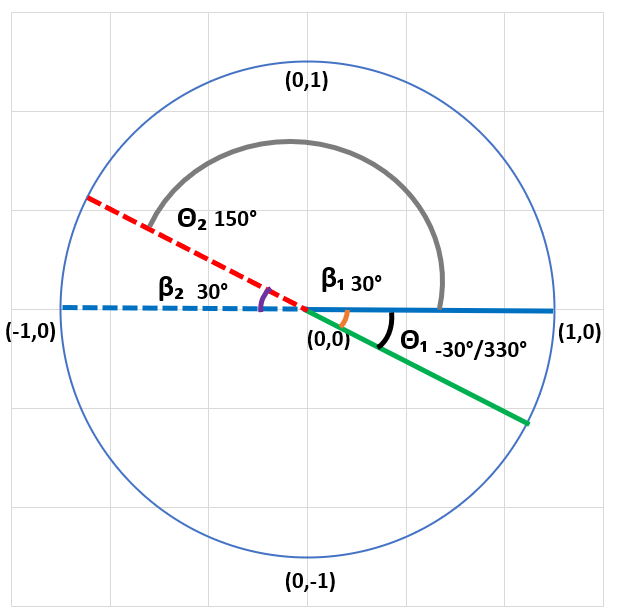
First, we can find the Principal Angle by finding inverse of the trigonometric ratio:
\(\tan\theta = \cfrac{1}{\sqrt{3}}\)
\(\theta = \tan^{-1}\left(\cfrac{1}{\sqrt{3}}\right)\)
\(\theta = -30°\)
Given that this is a negative angle, we can add \(360°\) to it to determine its positive angle equivalent and Quadrant:
\(\theta = 360° + (-30°)\)
\(\theta = 330°\)
This is one solution in Quadrant \(4\). We can now calculate the Related Acute Angle. Given that \(\theta\) resides in Quadrant \(4\), we will use its corresponding equation:
\(\beta = 360° - \theta\)
\(\beta = 360° - 330°\)
\(\beta = 30°\)
We now need to determine the Corresponding Angle. We know that \(\tan \theta\) is negative so according to CAST, the solutions are in Quadrants \(2\) and \(4\). Since the solution we got from the calculator is in Quadrant \(4\), this means that the Corresponding Angle lies in Quadrant \(2\).
In order to calculate the Corresponding Angle, we can subtract the related accute angle \(30°\) from \(180°\):
\(\theta_2 = 180° - 30°\)
\(\theta_2 = 150°\)
Using the Principal and Corresponding Angles (\(330°\) and \(150°\) respectively), we can sketch our graph: