Mix of Factoring Methods
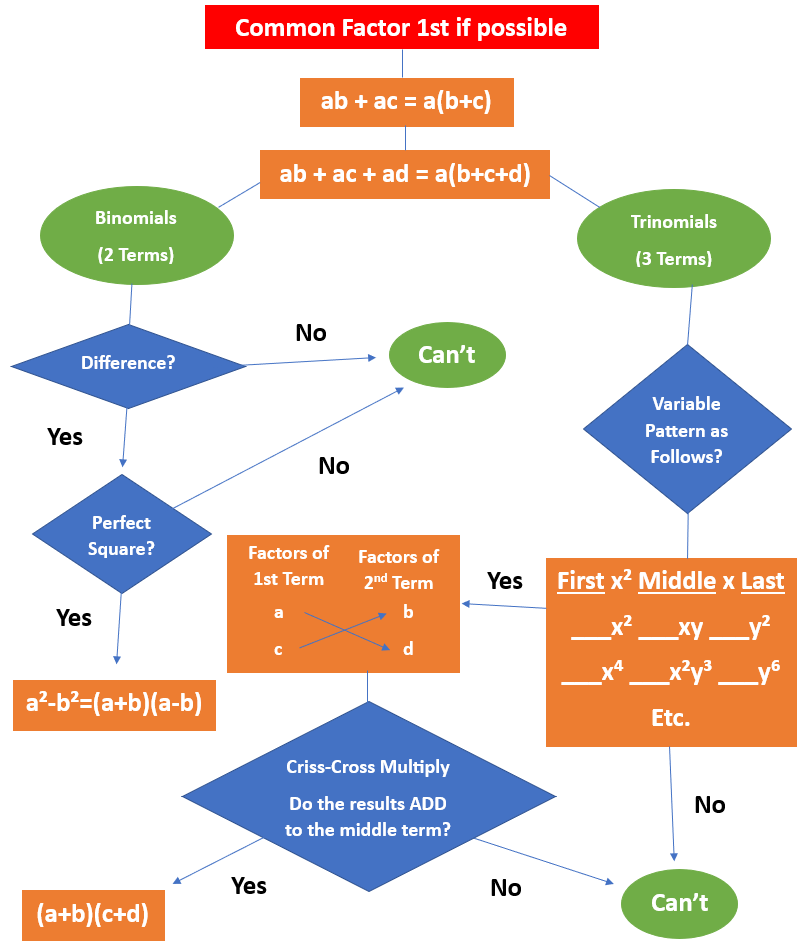
This lesson is meant to act as a review for the different types of factoring techniques that we have covered over the past few lessons. Below is a flowchart that shows which technique to use based on the given equation:
\(8x^3-4x^2\)
First, we can find the GFC in all the terms by factorizing the terms:
\(8x^3 = 2.2.2.x.x.x\)
\(4x^2 = 2.2.x.x\)
Since we can identify \(4x^2\) as the GCF, we can now express each term as the product of \(4x^2\) and another factor:
\(8x^3 = (4x^2)(2x)\)
\(4x^2 = (4x^2)(1)\)
This equation can be rewritten as \((4x^2)(2x) + (4x^2)(1)\).
Finally, we can apply distributive property to factor out \(4x^2\):
Therefore, we can determine that \(8x^3-4x^2\) fully factored is \(\boldsymbol{4x^2(2x + 1)}\).
\(4x^2-28x+40\)
First, we can identify a GFC, in this case \(4\). We can then simplify the equation by factoring out the GFC:
Next, as this is a trinomial expression, we can identify \(a = 1\), \(b=-7\) and \(c=10\).
Then, we need to identify two integers whose product is \((1)(10) = 10\) and sum is \(-7\). We can identify these values as \(-5\) and \(-2\).
Now that we have our terms, we can split \(b\) into its respective terms:
We can split the terms into two pairs and factor the GCF out of both to get the fully factored expression:
\(= 4[(x^2-5x)(-2x+10)]\)
\(= 4[\textcolor{red}{x}(x-5)\textcolor{red}{-2}(x-5)]\)
\(= 4[(x-5)(x-2)]\)
Therefore, we can determine that \(4x^2-28x+40\) fully factored is \(\boldsymbol{4[(x-5)(x-2)]}\).
\(16x^2-49\)
We cannot find a GFC to factor out of this equation and simplify.
First, we can identify this equation as a difference of squares since it follows the form \(a^2-b^2\).
Next, we can identify \(a^2 = 16x^2\) and \(b^2 = 49\).
Then, we can find the square roots of \(a^2\) and \(b^2\) to determine if they are whole numbers:
\(a = \sqrt{16x^2}\)
\(\textcolor{red}{a = 4x}\)
\(b = \sqrt{49}\)
\(\textcolor{blue}{b = 7}\)
Finally, we can place these terms into two identical binomials, with one adding to each other and the other subtracting from each other:
Therefore, we can determine that \(16x^2-49\) fully factored is \(\boldsymbol{(4x+7)(4x-7)}\).
\(4x^2-44x+121\)
We cannot find a GFC to factor out of this equation and simplify.
First, as this is a trinomial equation, we can identify \(a = 4\), \(b = -44\) and \(c = 121\).
We need to identify two integers whose product is \((4)(121) = 484\) and sum is \(-44\). We can identify both of these values as \(-22\).
Now that we have our terms, we can split \(b\) into its respective terms:
We can split the terms into two pairs and factor the GCF out of both to get the fully factored expression:
\(= \textcolor{red}{2x}(2x-11)\textcolor{red}{-11}(2x-11)]\)
\(= (2x-11)(2x-11)\)
Since both pairs are the exact same, we can rewrite the factored equation as such:
Therefore, we can determine that \(4x^2-44x+121\) fully factored is \(\boldsymbol{(2x-11)^2}\).
\(2y^2-20\)
First, we can identify a GFC, in this case \(2\). We can then simplify the equation by factoring out the GFC:
Next, we can identify this equation as a difference of squares since it follows the form \(a^2-b^2\).
Then, we can identify \(a^2 = 2y^2\) and \(b^2 = 20\).
After, we can find the square roots of \(a^2\) and \(b^2\) to determine if they are whole numbers:
\(a = \sqrt{y^2}\)
\(\textcolor{red}{a = y}\)
\(b = \sqrt{10}\)
\(\textcolor{blue}{b = 3.16}\)
Since we have determined that the square root of \(b\) isn't a whole number, we cannot factor this equation any further.
\((2c-5)^2-121\)
We cannot find a GFC to factor out of this equation and simplify.
First, we can identify this equation as a difference of squares since it follows the form \(a^2-b^2\).
Next, we can identify \(a^2 = (2c-5)^2\) and \(b^2 = 121\).
Then, we can find the square roots of \(a^2\) and \(b^2\) to determine if they are whole numbers:
\(a = \sqrt{(2c-5)^2}\)
\(\textcolor{red}{a = 2c-5}\)
\(b = \sqrt{121}\)
\(\textcolor{blue}{b = 11}\)
After, we can place these terms into two identical binomials, with one adding to each other and the other subtracting from each other:
Finally, we can simplify this equation further by collecting like terms and factoring out the GFC out of each pair:
\(= (2c+6)(2c-16)\)
\(= 2(c+3)2(c-8)\)
\(= 4(c+3)(c-8)\)
Therefore, we can determine that\((2c-5)^2-121\) fully factored is \(\boldsymbol{4(c+3)(c-8)}\).