Fractions
A fraction is a part of a whole number. Fractions appear in our lives everyday: eating a slice of a whole pizza that was cut into eight, separating a class of \(20\) students into groups of \(5\), \(5\), and \(10\).
A fraction is written with a numerator on top and denominator on the bottom separated by a line such as \(\frac{1}{8}, \frac{5}{20} \). The denominator tells you how many pieces the whole was separated into (like a pizza cut into 8 equal slices). The numerator tells you how many are of interest (like eating 1 of the 8 slices). If you eat \(1\) of \(8\) slices, than \( \frac{7}{8} \) are left.
You can visually represent fractions by taking an object, dividing it into equal parts and shading in the parts of interest.
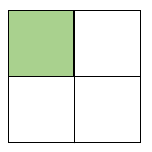
|
\(\cfrac{1}{4}\)
|

|
\(\cfrac{2}{3}\)
|
Equivalent Fractions
Equivalent fractions are fractions that are written differently but are actually equal. For example, if you cut up a pizza into \(4\) slices and eat \(2\) of them you have eaten half the pizza (\(\frac{2}{4}\)) which is the same thing as cutting up the same pizza into 6 slices and eating 3 slices (\(\frac{3}{6}\)). Both of these are equivalent to \(\frac{1}{2}\). All three of these fractions are equal or equivalent:
\(\cfrac{2}{4} = \cfrac{3}{6} = \cfrac{1}{2}\)
You can make an equivalent fraction by multiplying or divided both the numerator and denominator of a fraction by the same number. Let's take the fraction \( \frac{6}{14} \) and create an equivalent fraction by multiply the numerator and denominator by \(3\) and another equivalent fraction by dividing both the numerator and denominator by \(2\):
\( \cfrac{6}{14} = \cfrac{6*3}{14*3} = \cfrac{18}{42}\)
\( \cfrac{6}{14} = \cfrac{6/2}{14/2} = \cfrac{3}{7}\)
All of these fractions are equivalent:
\(\cfrac{6}{14} = \cfrac{18}{42} = \cfrac{3}{7}\)
Why does this work? Well, when you multiply/divide by the same number to the numerator and denominator, you are effectively multiplying the fraction by \(1\). When you multiply something by \(1\), it does not change! This is a math trick to manipulate numbers (or expressions) you will see throughout your math classes.
First, we need to multiply the top and bottom of the first fraction by the same value to set the denominator equal to that of the second fraction. In this instance, we can multiply the entire fraction by \(3\):
\( \cfrac{2}{7}\)
\(= \cfrac{2*3}{7*3} \)
\(= \cfrac{6}{21}\)
We can then compare their numerators to verify whether or not they're equivalent:
\(\cfrac{6}{21} > \cfrac{4}{21}\)
The fractions are not equivalent since the numerators are different. The first fraction is larger.
Reducing Fractions
Reducing a fraction means to find an equivalent fraction with the lowest, simpliest numbers such that you cannot reduce it anymore. To reduce a fraction, we will divide the numerator and denominator by the same number. You need to use factors of the numerator/denominator so that when you divide it, you end up with a whole number.
Example
Reduce the fraction \( \cfrac{20}{100}\).
We want to find a number to divde both the top and bottom so that we get whole numbers. We can divide both by \(2\):
\(\cfrac{20}{100} = \cfrac{20/2}{100/2} = \cfrac{10}{50}\)
But notice, we can continue reducing! There are other numbers we can divde by to simplify this fraction. Let's divide them both by \(10\):
\(\cfrac{10}{50} = \cfrac{10/10}{50/10} = \cfrac{1}{5}\)
We cannot reduce any further because the numerator is 1. You cannot divde it by anything because it will give a fraction. Therefore, we reduced the fraction to its lowest terms:
\(\cfrac{20}{100} = \cfrac{1}{5}\)
Now, there are a lot of different ways we could have ended up with this answer. The fastest way is to find the greatest common factor (GCF) between the numerator and denominator:
\(20: 20, 1, 10, 2, 5, 4\)
\(100: 100, 1, 50, 2, 25, 4, 5, 20, 10\)
The greatest common factor is \(20\) so dividing both top and bottom by \(20\) would give us the reduced fraction:
\(\cfrac{20}{100} = \cfrac{20/20}{100/20} = \cfrac{1}{5}\)
NOTE: try to divde both top and bottom by the numerator. That will give you a \(1\) in the numerator and reduce the fraction (only if you get a whole number in the denominator!).
To reduce the fraction, we will need to divide the top and bottom by the same number such that we end up with whole numbers. We can find the greatest common factors:
\(48: 48, 1, 24, 2, 16, 3, 12, 4, 8, 6\)
\(21: 21, 1, 7, 3\)
The greatest common factor is \(3\) so we will divde top and bottom by \(3\):
\( \cfrac{48}{21}\)
\(= \cfrac{48/3}{21/3}\)
\(= \cfrac{16}{7}\)
Reducing \(\cfrac{48}{21}\) gives us \(\boldsymbol{ \cfrac{16}{7}}\). Remember, these are equivalent fractions!
Converting Fractions to Decimals
Since fractions are part of a whole, we can represent them with decimal numbers. For example, \(\cfrac{1}{2} = 0.5\).
To convert a fraction to decimal, you can divide the numbers in your calculate. Give it a try, what is \(\cfrac{3}{8} \) as a decimal? Since dividing numbers by \(100\) is nice and easy, one strategy is to write an equivalent fraction with a denominator of \(100\). Then you can conert to decimal without a calculator.
Example
Convert \(\cfrac{6}{25}\) to a decimal number.
We want to write an equivalent fraction with a bottom of \(100\):
\(\cfrac{6*?}{25*?} = \cfrac{?}{100}\)
In order to turn the \(25\) to \(100\) we have to multiply by \(4\). We will also need to multiply the top by \(4\) to keep the fractions equal:
\(\cfrac{6*4}{25*4} = \cfrac{24}{100}\)
Since a fraction represents division, dividing \(24\) by \(100\) involves moving the decimal point two places to the left:
\(\cfrac{24}{100} = 0.24\)
Therefore, \(\cfrac{6}{25}\) is \(\boldsymbol{0.24}\) as a decimal.
Not all numbers will work out this nicely. You can try to write an equivalent fraction using a base with tens like \(10, 100, 1000\).
Converting Fractions to Percents
We might also want to express a fraction as a percent. This could be helpful to see how much of a whole the fraction occupies. To convert a fraction to a percent, first convert to a decimal. Then multiply by \(100%\):
\( = \cfrac{24}{100} = 0.24 \)
\(0.24 * 100\% = 24\% \)